Long COVID


"Long COVID (LC) is broadly defined as signs, symptoms, and conditions that continue or develop after initial COVID-19 or SARS-CoV-2 infection. The signs, symptoms, and conditions are present four weeks or more after the initial phase of infection; may be multisystemic; and may present with a relapsing-remitting pattern and progression or worsening over time, with the possibility of severe and life-threatening events even months or years after infection. Long COVID is not one condition. It represents many potentially overlapping entities, likely with different biological causes and different sets of risk factors and outcomes".
This working definition was developed by the U.S. Department of Health and Human Services in collaboration with CDC, NIH, patient groups, medical societies, and experts inside and outside the government under the Biden Administration.
According to the National Academies, Long COVID, present for at least 3 months, can manifest in more than 200 symptoms and medical conditions, including exacerbation of pre-existing conditions, and conditions affecting multiple organ systems. This infection-associated chronic condition can follow SARS-CoV-2 infections of any severity, including those that are asymptomatic. LC can range from mild to severe and resolve over a period of months or persist for months or years. No symptoms or conditions included in the definition are required or exclusionary. Everyone is susceptible to LC, including children and adults, regardless of previous health profile, disability or socioeconomic status, age, sex, gender, sexual orientation, race, ethnicity, or geographic location.
"Long COVID is not a Single Disease, Rather an Umbrella Term"
To understand this concept, read the article by Lindsay Boyce, BS, MLIS, Research Informationist III at Memorial Sloan Kettering Cancer Center. Boyce highlighted The American Medical Association's podcast that featured Akiko Iwasaki, PhD, Sterling Professor of Immunobiology at Yale University on April 7, 2025. In a discussion about Long COVID research, emerging treatments, and the latest from the Yale Long COVID Clinic, Dr. Iwasaki, PhD, whom we featured in an Expert Forum in 2023, talked about multiple potential etiologies that have been identified, pathogenesis, risk factors, the need for the layered approach in prevention and the need to create separate medical trials for interventions that target different endotypes based on different root causes.
The CDC’s Clinical Overview of Long COVID listed potential etiologies include:
- Organ damage resulting from acute phase infection
- Complications from a dysregulated inflammatory state
- Microvascular dysfunction
- Ongoing viral activity associated with an intra-host viral reservoir
- Autoimmunity
- Inadequate antibody response
Studies show that COVID infection can damage our brain function. Blood clots in the brain can persist in LC, depriving brain tissues of oxygen. One study reveals that COVID can cause or worsen diabetes. Another study shows that SARS-CoV-2 infection is associated with an increased risk of new-onset chronic kidney disease (CKD) (Stage 2+) and worsening kidney function, particularly among children with preexisting CKD or acute-phase acute kidney injury (AKI). A study by researchers at Cleveland Clinic shows how COVID-induced inflammation disproportionately affects individuals with preexisting inflammatory autoimmune conditions, such as Crohn’s disease, lupus, and rheumatoid arthritis, due to Long-term circulating SARS-CoV-2 ORF8, detected in the COVID + IMID (Immune-mediated inflammatory) group. Up to 25% of individuals living with Long COVID report bone-related symptoms, including bone pain and density loss. A retrospective cohort study in eClinical Medicine, highlighted in the library guides at Memorial Sloan Kettering Cancer Center, found those who had COVID had much higher risk of autoimmune diseases, including Rheumatoid Arthritis, Ankylosing Spondylitis, Systemic Lupus Erythematosus, Dermatopolymyositis. Systemic Sclerosis, Sjögren's Syndrome, Mixed Connective Tissue Disease, Behçet's Disease, Polymyalgia Rheumatica, Vasculitis, Psoriasis, Inflammatory Bowel Disease, Celiac Disease, Type 1 Diabetes, and Graves' Disease. Studies in mice showed that COVID and the flu can trigger both local and systemic inflammation, causing the awakening of dormant breast cancer cells in the lungs, leading to a significant expansion and the formation of metastatic lesions. A review based on findings in bioinformatics and vitro studies suggested that SARS-CoV-2 possesses oncogenic potential. COVID can promote metastasis by upregulating mesenchymal markers, cause damage to DNA, impair response to DNA damage, induce immunosuppression and oxidative stress, reactivate latent oncogenic viruses, and drive proinflammatory cytokines that create an environment that promotes tumor growth. An infection may impact multiple hallmarks of cancer through SARS-CoV-2 proteins and interactions with cellular pathways.
Stay Up to Date with the Latest Research with LitCOVID
LitCOVID is the most comprehensive resource on Long COVID, providing central access to articles on Long COVID in PubMed.
Long COVID Disability
Long COVID is a disability in some cases. The U.S. Department of Health and Human Services and the Department of Justice jointly published guidance on Long COVID as a disability under the Americans with Disabilities Act (ADA), Section 504 of the Rehabilitation Act, and Section 1557 of the Affordable Care Act. The CDC’s Long COVID Resources webpage provides legal information regarding Disability for LC patients.
Clinical Trials and Research Participation
If you are interested in supporting research or joining Long COVID clinical trials for treatment, here’s a short list of organizations to follow:
- RECOVER: Researching COVID to Enhance Recovery
- PECOS: Pediatric COVID Outcomes Study
- LIINC: Long Term Impact of Infection with Novel Coronavirus
- Cardiac Magnetic Resonance Tissue Characterization in COVID-19 Survivors
- Understanding the Long-term Impact of COVID on Children and Families
- Recruiting Long COVID Trials
- Johns Hopkins COVID Long Study
- KU Medical Center COVID/Post-COVID Trials
- Cure ID
- RECOVER-TLC
- Long COVID Alliance
A Layered Approach to Prevention Works Best
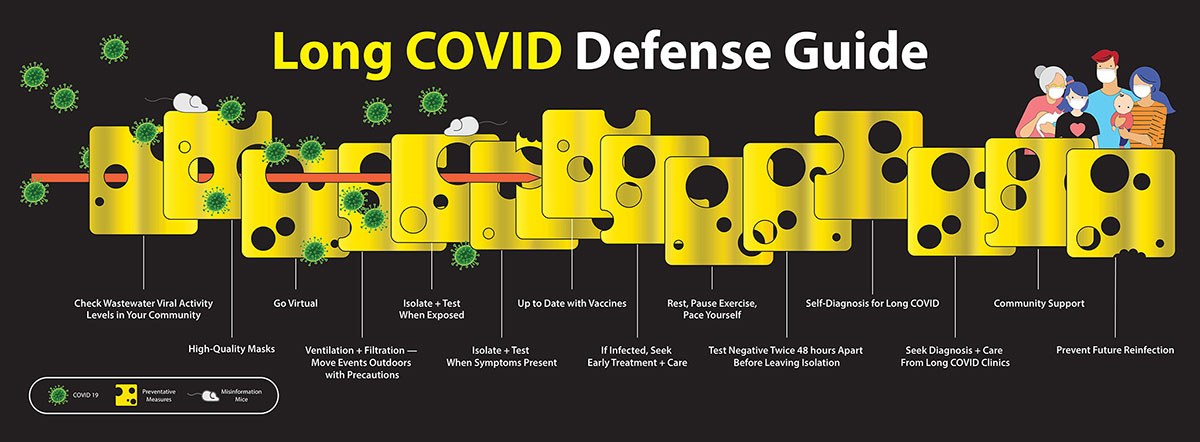
We need to normalize prevention. Each infection can lead to new onset conditions including Cardiovascular Diseases, Stroke, Cardiac Arrest, Interstitial Lung Disease, Hypertension, Thromboembolism, Microclots, Hyperglycemia (Diabetes Mellitis), Myalgic Encephalomyelitis/Chronic Fatigue Syndrome (ME/CFS), Postural Orthostatic Tachycardia Syndrome (POTS), Virus Reactivation (especially Epstein-Barr Virus and Human Herpesvirus 6), Autoimmune Diseases, Erectile Dysfunction (ED), Infertility (female and male), Acute Kidney Disease (AKD), Neuropathies, Renal Failure, Tinnitus (ringing in the ears), Dementia/Alzheimer’s Disease, Parkinson's Disease, Mood Disorders, Attention Disorders, Type 1 Diabetes Mellitus, Type 2 Diabetes Mellitus, Immune Damage and possibly Cancers.
The best way to prevent Long COVID is to avoid infection and reinfection. While the COVID vaccine remains an important measure to prevent SARS-CoV-2 infection and severe outcomes, a study by researchers at the Mayo Clinic found that even if an individual is vaccinated, they can still develop LC if infected. Prevention requires a layered approach: besides getting vaccinated, we recommend wearing well-fitting high filtration respirators and using other tools and measures such as ventilation and filtration, early treatment, and rest.
The Swiss Cheese Layered Approach recognizes that no single intervention is perfect. Each layer has its own holes and flaws and might not be accessible or feasible for everyone. Source control requires collective action. Having more tools provides more options and protection, and we are sharing key strategies to prevent Long COVID.
Learn from Frontline and Patients
Since 2020, advocates from MaskTogetherAmerica have been learning from patients and healthcare professionals about Long COVID. Many volunteers shared their LC stories to support awareness. We invite you to watch our first series of testimonials by long haulers who held nothing back to warn the world about Long COVID to support our campaign at the start of the pandemic.
Long Covid Silenced Timothy Boswick
Timothy Boswick, professional musician, opera singer, Doctoral Candidate at University of Illinois at Urbana-Champaign, was diagnosed with COVID-19 on March 27, 2021. Since contracting COVID-19, Timothy hasn't been able to sing. 3 months after the initial infection, Timothy was diagnosed with vocal nodules. Long Covid forced a baritone into silence. It also affected his mental health. Timothy developed anxiety and was diagnosed with PTSD. As the author of Voices of COVID-19 for the National Association of Teachers of Singing, Timothy talks about devastation and loss caused by the COVID-19 pandemic.
Long Covid took Dr. Marjorie Roberts’ Job and 7 Teeth
Dr. Majorie Roberts contracted COVID-19 at her workplace in April, 2020. Dr. Roberts was gaslighted by her primary physician, reducing her chance of recovery. She developed anxiety and many debilitating symptoms. Long Covid forced her to quit her job. Dr. Roberts can attest that COVID-19 can cause dry mouth and affect dental and oral health. After suffering from Long Covid for over 2 years, Dr. Roberts became an advocate for COVID survivors as a patient representative for the NIH Long Covid Recovery Program.
Long Covid Paralyzed Dr. Robi Tamargo
Dr. Robi Tamargo, licensed clinical psychologist, contracted COVID-19 from her patient, became acutely ill on May 7, 2020. Since then, Dr. Tamargo suffers from multi organ damage caused by COVID-19 and its long-term effects. She developed A-fib (atrial fibrillation), an irregular and rapid heart rhythm that can lead to blood clots in the heart. After COVID-19 destroyed her immune system, Dr. Tamargo was diagnosed with Guillain-Barré syndrome. Once active and healthy, she was hospitalized and disabled by the neurological disorder.
Long Covid Drove Candace Taylor to Homelessness
Candace Taylor, Former Healthcare Worker, has been disabled by Long Covid at age 37. COVID-19 reactivated her underlying health condition: complex regional pain syndrome, (CRPS), which was manageable until she was infected with COVID in March, 2020. Debilitating symptoms from Long Covid made her unable to keep a job, as a result, she lost her home.